
RenEnergy builds South Africa’s largest off-grid agricultural installation
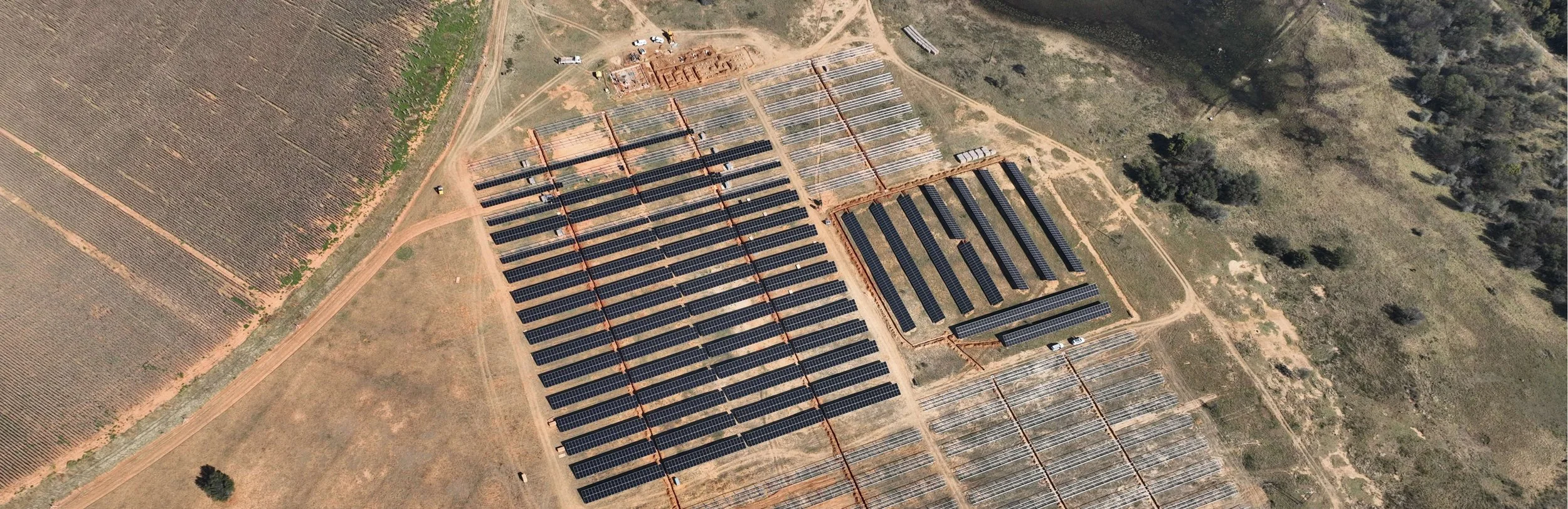
RenEnergy builds 4.89 MWp solar and 20 MWh battery system for a 2,000+ hectare Free State farm, South Africa’s largest off-grid agricultural site.
Press Release
Belle Rive Farm is set to become the largest off-grid agricultural solar-plus-storage installation in South Africa by battery energy storage capacity — a 20 MWh system engineered to eliminate grid dependency across irrigation, cold chain, and processing operations spanning over 2,000 hectares of Free State farmland.
A major Free State commercial farming operation has appointed RenEnergy as its EPC contractor to design and deliver what will be South Africa’s largest off-grid agricultural solar-plus-storage system. The installation — a ground-mounted 4.89 megawatt-peak (MWp) solar photovoltaic array paired with a 20 megawatt-hour (MWh) battery energy storage system (BESS) — is currently under construction and will serve Belle Rive Farm, a commercial farming operation spanning more than 2,000 hectares. Once complete, the system will distribute power across the site via approximately 17 kilometres of medium-voltage (MV) reticulation.
The 20 MWh BESS at Belle Rive is, based on available market data and supplier intelligence, the largest privately-contracted, purpose-built battery energy storage system deployed in service of an off-grid agricultural operation in South Africa.
According to GreenCape’s 2025 Market Intelligence Report, the entire behind-the-meter storage market for the Commercial, Industrial and Agricultural sector in South Africa is expected to stabilise at approximately 400 MWh of new installations per year.
A single privately-contracted agricultural installation of 20 MWh therefore represents 5% of annual national CI&A storage deployment — in one farm. Industry data published by ESS News, drawing on Africa Solar Industry Association (AFSIA) figures, confirms that most private behind-the-meter systems in Southern Africa sit in the 10–20 MWh range. Belle Rive sits at the ceiling of that range and, based on all evidence available at time of publication, stands alone as the largest of its kind in South African agriculture.
The 2,000+ hectare scale of the farm’s operational footprint is central to the engineering challenge. Distributing reliable, uninterrupted power across that distance — to irrigation systems, cold rooms, packhouses, and processing infrastructure running on a diverse multi-crop production calendar — requires a fundamentally different system architecture to a compact C&I or logistics installation. The Belle Rive system was designed to deliver energy continuity at agricultural scale, across the distances and load variability that commercial farming actually demands.
Belle Rive Farm operates across seed potatoes, ware potatoes, pecan nuts, onions, and maize — a production base with hard dependencies on energy continuity throughout seasonal cycles. Irrigation systems, cold storage, and processing infrastructure run continuously during peak production periods, and seasonal windows leave no margin for power interruptions.
The investment was driven by compounding grid cost exposure. Eskom tariffs for direct customers increased by 12.74% in April 2025, following increases of 18.65% in 2023 and 12.72% in 2024, with a further 8.76% increase effective 1 April 2026. Electricity contributes approximately 6% to total agricultural production input costs nationally — a figure that rises materially for operations with significant cold chain and irrigation load. Agri SA has cautioned that without structural intervention, sustained tariff escalation risks pushing energy-exposed farming operations into financial distress.
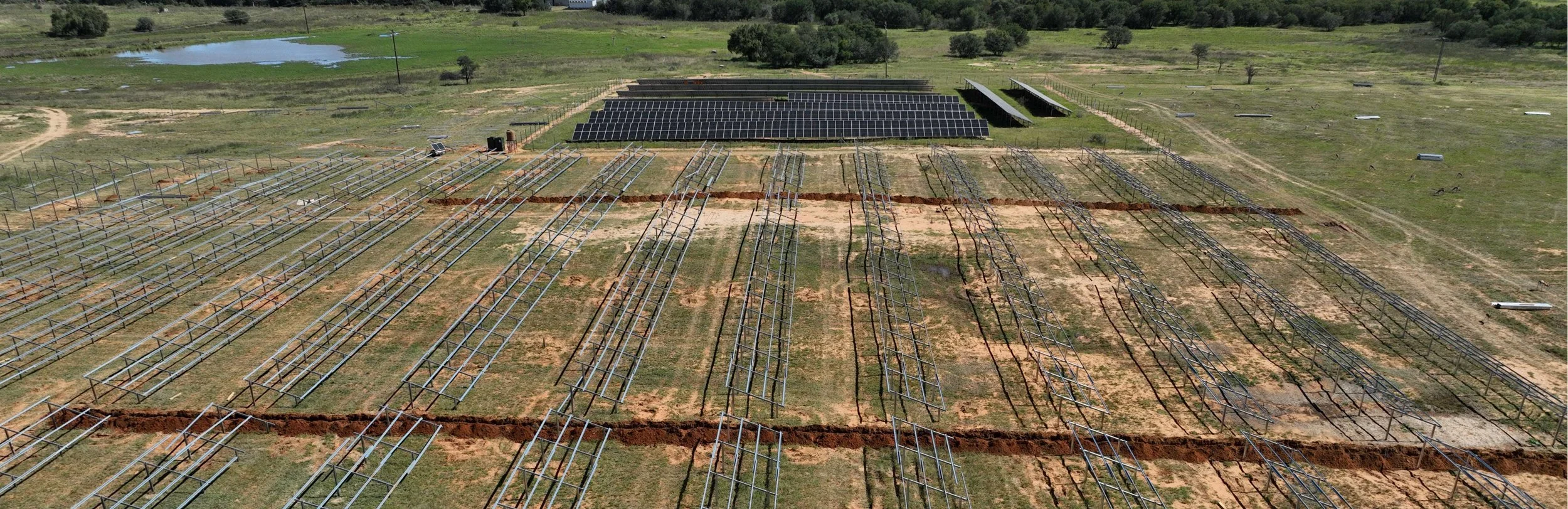
The early stages of the Belle Rive project, where engineering is translated into construction.
“We had reached a point where the question wasn’t whether to invest in energy independence, but how quickly we could make it happen. Our operations run across a large area of farmland — there’s no room for power interruptions when you’re managing cold storage and irrigation at this scale. This installation gives us the certainty to plan and operate without that exposure.” – Stanley de Beer, Owner of Belle Rive Farm
As with all RenEnergy projects, the system design was informed by detailed load analysis rather than a standard commercial template. At Belle Rive, the scale and complexity of the farming operation made this especially critical. The engineering team conducted half-hourly consumption analysis across multiple supply points, profiled load behaviour across seasonal agricultural cycles, and assessed major farm equipment before arriving at the final system configuration. The 20 MWh BESS sizing reflects the farm’s requirement to sustain critical loads through the night and across extended overcast periods, without fallback to diesel or the Eskom grid.
“Delivering a 20 MWh off-grid system across more than 2,000 hectares of active farmland is not a standard brief. Commercial agriculture has a fundamentally different demand profile to logistics or manufacturing — it is seasonal, operationally critical, and unforgiving of interruptions. What makes Belle Rive significant is not just the scale of the BESS, but what that scale has to do: keep cold chain, irrigation, and processing running continuously, across a farm of its size. This is what genuine energy independence looks like for South African agriculture.” – Juandré Pitout, Head of Business Development at RenEnergy
South Africa’s commercial farming sector is approaching an inflection point on energy. Solar PV combined with battery energy storage is now cost-competitive with grid electricity and substantially cheaper than diesel generation, even before accounting for productivity losses from power interruptions. GreenCape projects the BTM storage market for the CI&A sector will reach 2 GWh of cumulative installed capacity by 2030 — driven by falling storage costs, sustained tariff pressure, and the operational imperatives of industries that cannot absorb energy uncertainty.
Belle Rive Farm’s decision to go fully off-grid reflects a pattern now emerging across South Africa’s larger commercial farming operations: energy is no longer an operating cost to be managed incrementally, but a capital investment with a defined return, a long asset life, and a direct bearing on competitive viability.